
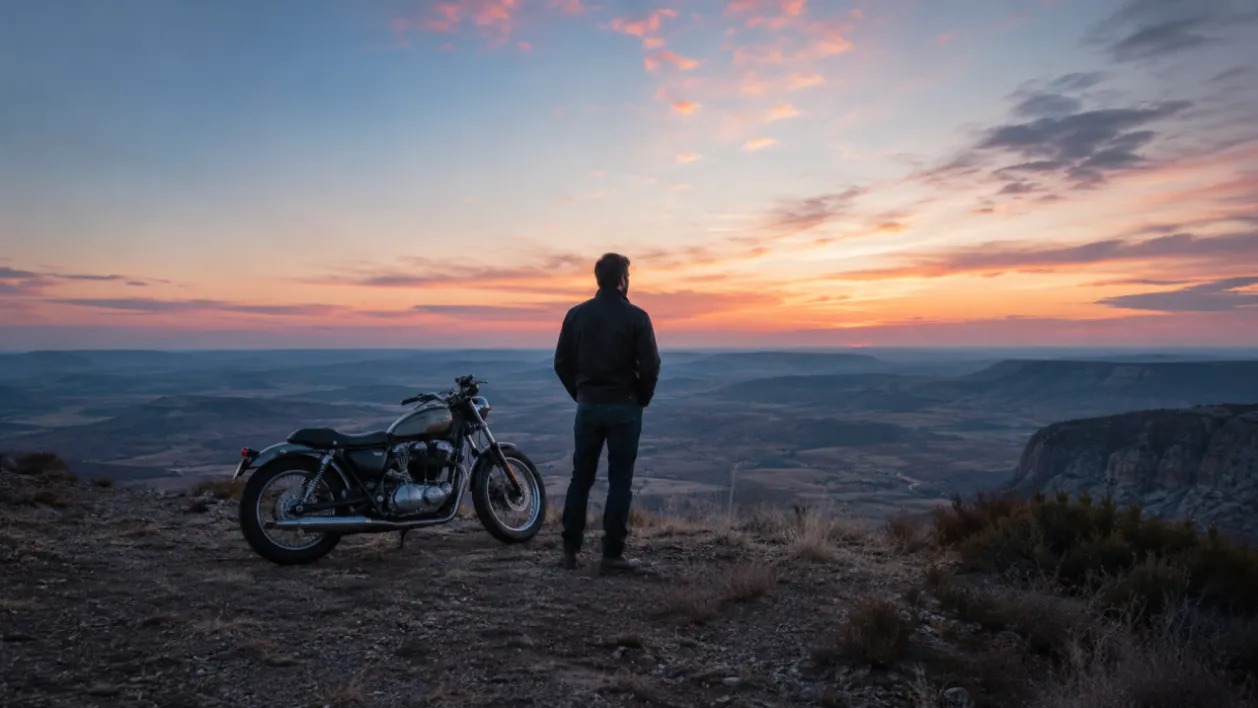
Today, America turns 250.
I’m full of gratitude for the immigrants, pioneers, soldiers, adventurers, builders, and innovators who helped make America. I was lucky to be born when I was, where I was, in a country where a kid who loved business and motorcycles could eventually buy out his boss and become an owner/operator in the motorcycle and powersports business at 25 years old.
That opportunity changed the direction of my life. It gave me a front-row seat to entrepreneurship, risk, customer service, community, and the joy that comes when a family discovers motorcycles, side-by-sides, snowmobiles, or outdoor adventure for the first time. America is not the only place where innovation happens, but our first 250 years are one of history’s strongest examples of how freedom, entrepreneurship, and innovation can expand prosperity and human choice. That is why I think the motorcycle and powersports industry may be measuring the wrong growth curve.
For years, we have watched registrations, retail sales, inventory cycles, interest rates, financing approvals, and market share. Those numbers matter. But the bigger curve may be hiding in a more interesting question: what happens if more people can afford adventure, and the people who already own motorcycles and powersports vehicles have much more time to use them?
At the 2026 Motorcycle Industry Council Capitol Hill Fly-In, one of the talking points we shared with legislators was that the U.S. motorcycle and powersports industry is a $48.2 billion industry contributing to economies across all 50 states. MIC’s public numbers also show 9.5 million registered motorcycles, 11 million motorcycles in use in the U.S., including on- and off-road bikes, and 30 million annual motorcycling riders. I do not see those numbers as a ceiling. I see them as the early base of a much larger participation and utilization curve.
The public data is cleaner for motorcycles than for total powersports participation. A household with a street bike may also have dirt bikes. A family with a side-by-side may also own motorcycles or personal watercraft. Some participants are passengers, kids, rental customers, guided-ride customers, or occasional users who do not show up neatly in the same dataset. So I think the better way to look at the future is not one perfect “powersports rider” number. It is a ladder: owners, occasional riders, passengers, outdoor families, first-time buyers, dealership-event participants, and future frequent adventurers.
Utilization may be the most overlooked part of the story. FHWA’s 2023 Highway Statistics show average miles traveled per registered motorcycle at just over 2,100 miles per year. A motorcycle ridden 800 or 2,000 miles a year has a very different economic and lifestyle impact than one ridden 5,000 or 8,000 miles a year. A side-by-side that sits most of the year is very different from one that becomes part of a family’s monthly rhythm. If we only count units, we miss the bigger opportunity: more days outside, more tires, more service visits, more accessories, more trips, more community, and more customers who build part of their identity around riding.
This is where Elon Musk’s abundance thesis becomes relevant to powersports. Tesla’s Master Plan Part IV describes a future where AI moves into the physical world through manufacturing, autonomy, energy, and robotics to accelerate global prosperity and human thriving. Musk may be too aggressive on timing and magnitude. He often is. But if AI, robotics, and automation create lower costs, higher productivity, and more discretionary time, OEMs should be asking a much bigger question: what happens when the world has the equivalent of more Saturdays?
Most powersports customers today are still weekend warriors. In a more prosperous and more automated world, some households may effectively have the equivalent of three Saturdays a week. I do not mean that as a literal forecast. I mean it as a way to think about what happens when work, cost, and time constraints loosen. The family that uses a side-by-side three times a year may use it three times a month. The motorcycle owner who rides occasionally may start planning trips, events, and friendships around riding. The parent who wants the kids outside may finally have the time and financial room to make dirt bikes, ATVs, or a side-by-side part of family life.
The U.S. already has the outdoor audience to support a much larger powersports economy. The Outdoor Industry Association reported that 181.1 million Americans participated in outdoor recreation in 2024, or 58.6% of Americans age six and older. That audience is far larger than today’s active rider base. If even a modest share of outdoor families moved into motorized outdoor adventure, the industry would feel very different.
A simple scenario shows the scale. If we use the $48.2 billion U.S. industry number and MIC’s 30 million annual motorcycling riders as a rough benchmark, the current economic impact is about $1,600 per annual motorcycling participant. If annual motorized outdoor adventure participation eventually reached one in four Americans, the U.S. opportunity could approach $137 billion at today’s rough economic intensity. I would not call that a forecast. It depends on major changes in affordability, financing, training, access, safety, dealer process, service capacity, and OEM product strategy. But as a sizing exercise, it makes the current market feel much earlier than many people assume.
The global version is even more interesting.
Europe already shows how deeply motorcycles and scooters can become part of daily mobility. ACEM says there are more than 39 million motorcycles and scooters on Europe’s roads, and registrations across five of Europe’s largest markets reached 1,155,640 units in 2024, up about 10.1% from the prior year. Europe is not the U.S. In many European markets, two-wheelers are practical transportation as much as recreation. The next global growth curve may combine both models: mobility first, then recreation and lifestyle as prosperity rises.
Africa may become one of the most important long-term opportunities in the world. The continent is young, growing, and full of extraordinary landscapes. The UN Economic Commission for Africa projects Africa’s working-age population will grow from 883 million in 2024 to 1.6 billion in 2050, representing almost a quarter of the global working-age population. If affordability, infrastructure, financing, and dealer development improve, I believe African markets could eventually adopt motorized outdoor adventure at rates much closer to Americans than many industry models assume.
That does not mean copying the U.S. model. Africa has an opportunity to build something better from the beginning: conservation-compatible recreation infrastructure, community-led land stewardship, responsible riding areas, local guide networks, protected wildlife corridors, and outdoor recreation businesses that give citizens economic reasons to preserve the landscapes they can also enjoy. Think about the Serengeti, the Okavango Delta, Victoria Falls, Kilimanjaro, Namibia’s deserts, South Africa’s coastlines, Zimbabwe’s granite landscapes, and thousands of local places the world barely knows. Responsible powersports growth should not turn sensitive wildlife areas into playgrounds. It should create managed access, local ownership, training, stewardship, and dealer infrastructure.
For global motorcycle and powersports OEM leaders, the strategic question is bigger than how to build better vehicles for today’s best customers. The better question is how to build the products, networks, financing, service systems, and dealer infrastructure for tomorrow’s first-generation adventure customers.
That requires a different kind of innovation. Not just premium technology, but affordability. Not just higher performance, but durability. Not just more features, but serviceability. Not just more distribution, but stronger dealer development.
I think the manufacturers that win the next era will stay focused on two priorities at the same time.
The first is innovation that results in affordability. AI, robotics, modular platforms, smarter manufacturing, better design, and stronger supply chains should not only produce more expensive flagship vehicles. They should help create reliable, exciting, safe, serviceable machines that millions more people can afford.
The second is a stronger global dealer network. If more humans become riders, and if riders ride more often, they will need great local dealerships. They will need help through the shopping and buying process. They will need ownership education, stocked maintenance parts, tires, batteries, belts, chains, filters, fluids, brake pads, suspension parts, safety gear, and trained technicians. They will need someone nearby who can keep the adventure going.
More participation is not only a sales opportunity. It is a service-capacity challenge. If future customers ride two or three times as often, maintenance demand rises quickly. Tires wear faster. Brake pads go quicker. Oil changes happen more often. Suspension service matters more. Batteries, belts, drivetrains, trailers, electronics, and accessories become more important to the ownership experience.
Dealerships will have to become more operationally excellent than ever. The future dealership needs stocked maintenance parts, better tire capacity, faster service intake, transparent communication, stronger technician productivity, better scheduling, mobile and remote diagnostics, customer education, and clean handoffs from sales to service. Robotics and AI will likely help, not by replacing great technicians, but by increasing maintenance and repair capacity through AI-assisted diagnostics, automated parts movement, smarter scheduling, inspection tools, technician workflow support, and eventually more advanced service assistance.
For dealership owners and operators, this is both the opportunity and the warning. The dealer who wins the next era will not simply be the one with inventory. It will be the one with process, trust, service communication, customer education, ownership support, community, and capacity. The dealer who can make a first-time buyer feel confident, then keep that customer riding, will be far more valuable in a world with more riders and more riding days.
Record motorcycle registrations may not be the end of the growth story. They may be the beginning.
If the future gives people more prosperity and the equivalent of more Saturdays, this industry can keep thinking in terms of today’s active rider base, or it can build for a much larger future where motorized outdoor adventure becomes accessible to hundreds of millions more people around the world.
That future will not happen by accident. It will require OEMs to innovate for affordability and durability. It will require dealers to build repeatable processes and world-class ownership experiences. It will require service infrastructure at global scale, along with responsibility, access, stewardship, training, financing, parts, and trust.
If we build it well, the next powersports growth curve could be much bigger than selling more units. It could be helping the world become more adventurous.
I’m going deeper on this idea in a four-part Herohub LinkedIn newsletter series in The AI Edit: Industry Shifts. The first article lays out the larger thesis: in a world of AI companions, autonomous cars, smart glasses, synthetic entertainment, and rising prosperity, real-world adventure may become more valuable than ever. The series will move from the macro AI shift, to the role of dealers as mentors into the real world, to the global opportunity for OEMs and dealer networks in markets that may be much earlier in the curve than we realize.
.svg)