
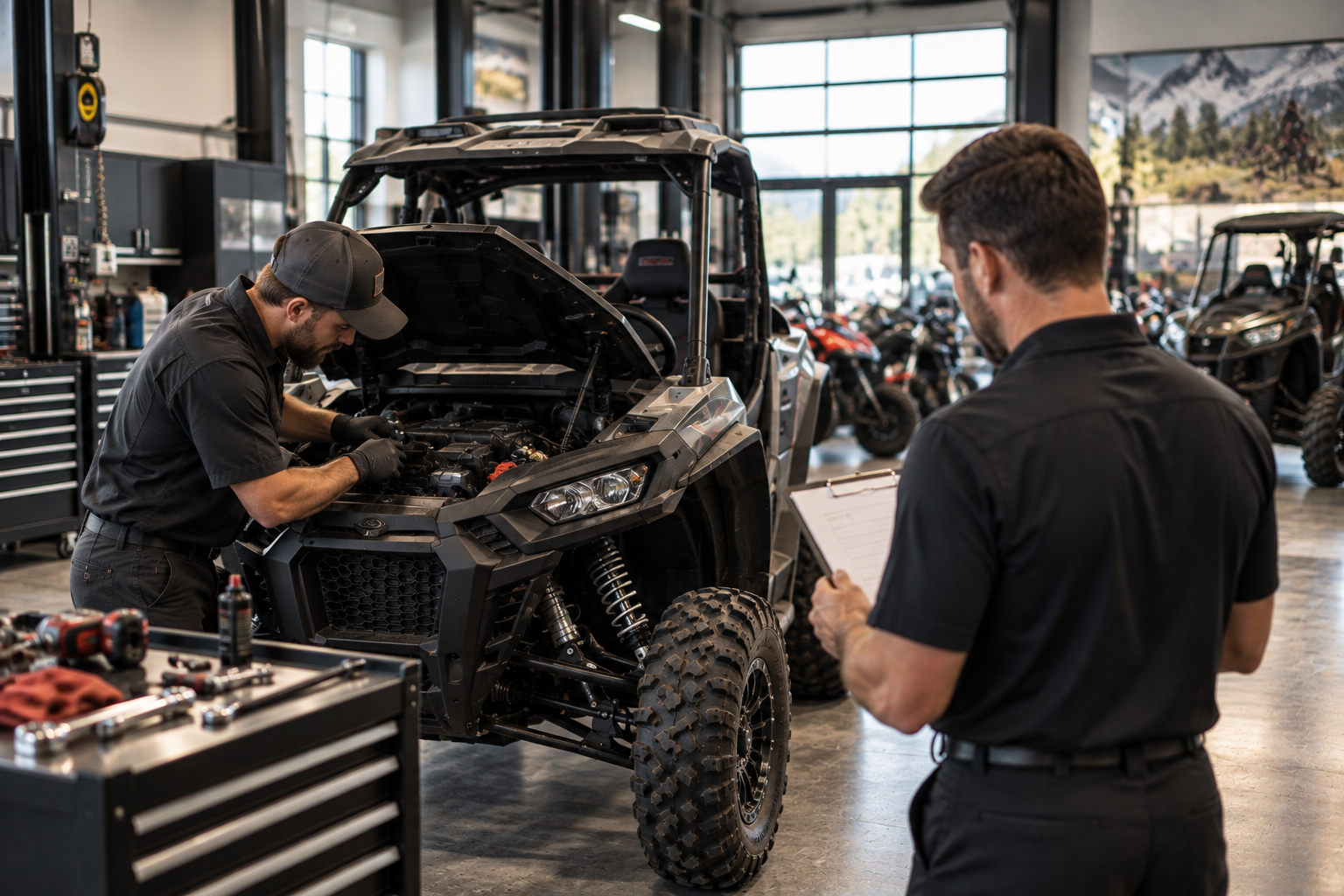
There is a conversation happening in powersports dealerships every day that deserves more attention.
A pre-owned unit comes in through a trade, a customer purchase, or an auction. It goes through the initial inspection, and then Service starts identifying everything that could be done to make the unit “like new.”
A Used Unit Isn't a Restoration Project
The objective of pre-owned reconditioning shouldn't be to return a used powersports unit to showroom-new condition. It should be to make the unit safe, reliable, presentable, competitively priced, and ready for a customer to buy. Those are very different objectives. Restoration is about making something as close to new as possible. Reconditioning is about making something retail-ready. And in a dealership environment, that distinction matters because every dollar spent on a used unit is dealership capital.
The question shouldn't always be: “What else can we do to this unit?”
The better question is: “What does this unit actually need to be sold confidently and profitably?”
The Service Department Isn't the Enemy
This isn't an argument against Service. Quite the opposite. A strong Service Department is essential to a successful pre-owned operation. Technicians are trained to identify problems, wear, safety concerns, and potential customer complaints. Their job is to make sure a unit is mechanically sound. The challenge comes when the definition of “good enough to retail” isn't clearly established between Service, Sales, Used Inventory Management, and dealership leadership. Without that definition, the technician naturally tends to do what they are trained to do: Fix everything they find.
Every Dollar of Recon Has a Job
Imagine a dealership takes a motorcycle in trade and values it at $8,000. After inspection, it needs $600 of legitimate mechanical work. That makes sense. But then another $1,500 of recommended work gets added because the unit could be made cleaner, newer, or closer to perfect. Now the dealership has $2,100 into reconditioning. The problem isn't necessarily the $2,100. The problem is whether the market will pay the dealership back for that $2,100. If the additional investment doesn't meaningfully increase the selling price, improve the likelihood of a sale, or reduce a meaningful ownership concern, the dealership may simply be converting gross profit into unnecessary reconditioning expense. Not every improvement creates value. A customer may appreciate a new set of grips. But they may not be willing to pay $150 more for them. The dealership needs to understand the difference between value to the customer and value to the technician.
Speed Is Part of Profitability
There is another cost to over-reconditioning that doesn't always show up on the repair order: Time. A pre-owned unit sitting in Service isn't generating a return. It's tying up capital. The dealership acquired that unit with the expectation that it would eventually be sold, grossed, and converted back into cash that can be invested into the next piece of inventory. Every additional day spent waiting for parts, scheduling work, approving additional repairs, or chasing cosmetic perfection delays that process.
The faster a dealership can move a unit through a disciplined inspection and reconditioning process, the faster it can get that unit: Acquired → Inspected → Reconditioned → Merchandised → Sold
And then the capital comes back. That's the real objective.
Reconditioning Should Start With a Standard
The answer isn't to tell Service to “do less.” The answer is to establish a clear reconditioning standard.
Every unit should have a defined process that answers several questions:
1. Is it safe?
Brakes, tires, steering, suspension, controls, fluids, electrical systems, and other critical mechanical components need to meet the dealership's safety standards.
2. Is it reliable?
Address the issues that could create an immediate customer concern or a preventable post-sale problem.
3. Is it presentable?
The unit needs to look like something a customer would be proud to own. That doesn't mean eliminating every scratch or imperfection. It means presenting the unit honestly and professionally.
4. Is it competitive?
Look at the actual market. What are comparable units selling for? What condition are they in? What does the dealership need to invest to position this unit correctly?
5. Is the investment justified?
This may be the most important question. Before spending another dollar, ask: Will this investment increase the unit's value, improve its ability to sell, reduce a meaningful customer concern, or protect the dealership from a legitimate problem? If the answer is no, reconsider the expense.
The Goal Isn't the Perfect Used Unit
There is a temptation in dealerships to believe that the best used inventory is the inventory that has received the most work. That's not necessarily true. The best pre-owned unit is the one that has received the right work. A $12,000 motorcycle doesn't need $4,000 of reconditioning just because someone can find $4,000 worth of things to improve. It needs the work required to make it a safe, reliable, attractive, properly represented $12,000 motorcycle. That's the difference between managing Service activity and managing dealership profitability.
Sales Has a Role, Too
This can't be owned by Service alone. Sales needs to understand what the dealership has invested, what the unit is worth, and how it is positioned in the market. Management needs to establish the standards. Service needs to identify legitimate mechanical and safety concerns. Sales needs to provide feedback about what customers are actually responding to. And leadership needs to monitor the numbers.
Because the real question isn't: “How much did we spend reconditioning this unit?” It's: “What return did we generate on the capital we invested in this unit?” That changes the conversation.
Get the Money Back to Work
Pre-owned inventory is one of the greatest opportunities in a powersports dealership. But it is also one of the easiest places to lose control of capital. A unit comes in. Money goes into it. More money goes into it. It sits. More money goes into it. Eventually it sells—but the dealership discovers that the additional investment didn't create the return it expected. That's not a reconditioning problem. That's an inventory management problem. The goal should be to create a disciplined process that gets every unit retail-ready without unnecessarily over-investing in it. Because when that unit sells, the dealership doesn't just make a sale. It gets its capital back. And that capital can immediately go back to work: The next trade. The next auction purchase. The next customer. The next opportunity.
The Bottom Line
That's what good pre-owned management is really about. Don't restore the unit. Recondition the investment. The best reconditioned unit isn't the one that received the most work. It's the one that received the right work, got to market quickly, sold profitably, and put the dealership's money back to work.
RECONDITION THE INVESTMENT.
.svg)