
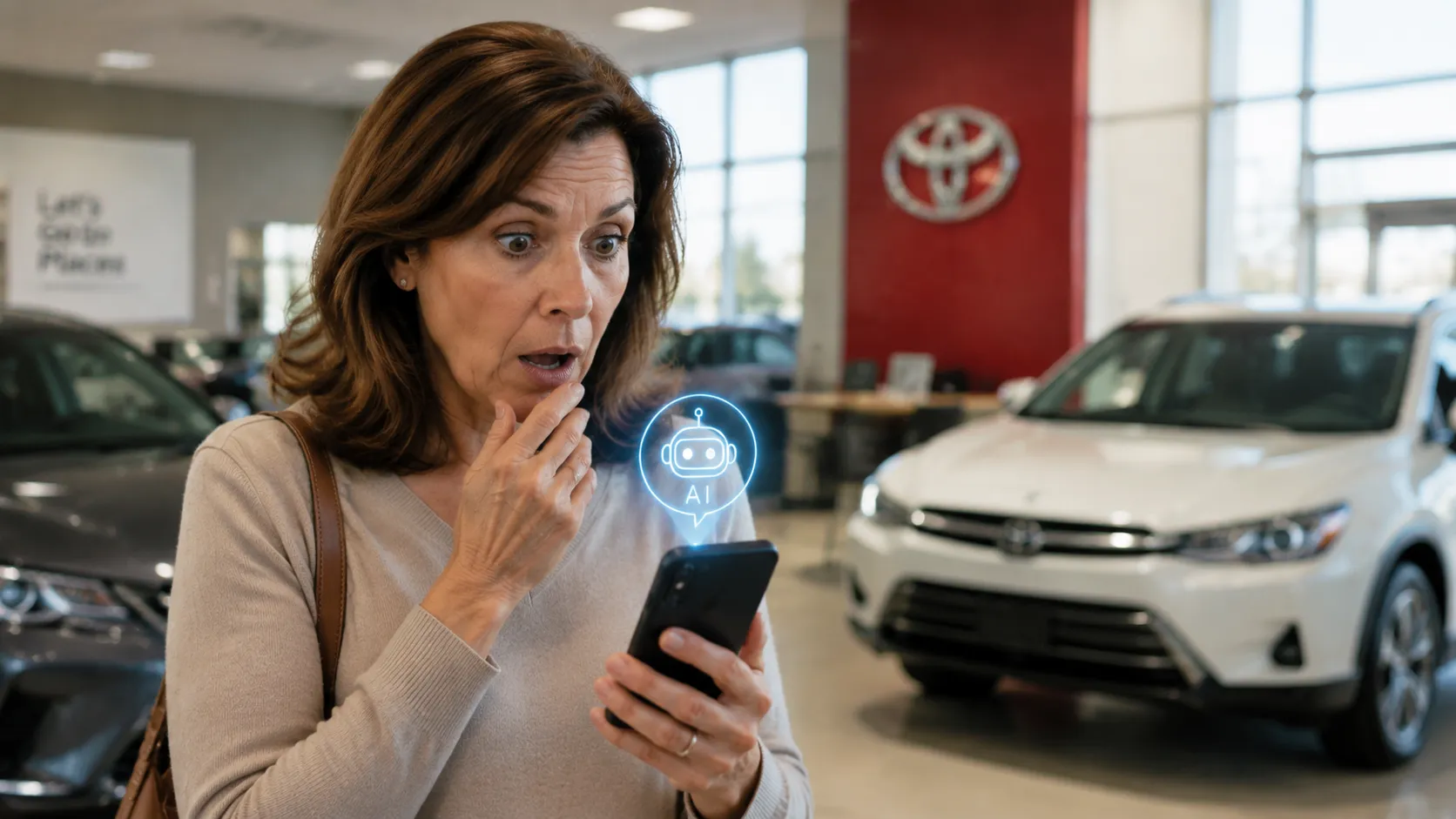
Recently, my mother-in-law needed to schedule service for her Toyota Highlander. Like many customers today, she was directed by the dealership’s service department to use the scheduling system on their website.
There, she began interacting with someone by name. The conversation happened through text messages, and from her perspective, she was communicating with a real person. There was no indication that she wasn’t.
The interaction was smooth, helpful & responsive.
In fact, it worked so well that when she arrived at the dealership, she asked if she could meet the person who had helped her schedule the appointment.
She was told that “she works remotely.”
Later, after additional questions and more text exchanges, the service manager clarified the truth: the person wasn’t a person at all. It was AI.
My mother-in-law was floored.
“That can’t be right,” she told me.
As someone who has spent years working with dealerships, I explained that AI scheduling and communication tools are becoming increasingly common. But that explanation didn’t change how she felt.
She felt duped.
Some might look at this story and conclude that it simply proves how advanced AI technology has become. And to some extent, that’s true.
I see a different lesson.
When we evaluate situations like this, we should do so through the lens most favorable to the human being involved. Customers deserve to know who, or what they are interacting with.
If your dealership or business chooses to use AI to improve convenience, responsiveness, or efficiency, that’s completely reasonable. In many cases, it’s a smart business decision.
Own it. Lean into it.
Tell customers they’re interacting with an AI assistant. Give it a name if you’d like, but don’t allow people to believe they are communicating with a human when they are not. Don’t imply it. Don’t hide it. And don’t rely on omission to create that impression.
Trust is hard to earn and easy to lose.
The future will undoubtedly include more AI in customer interactions. That’s not the issue. The issue is whether businesses choose transparency or deception as they adopt it.
My mother-in-law wasn’t upset because she interacted with AI.
She was upset because nobody told her she was.
.svg)